
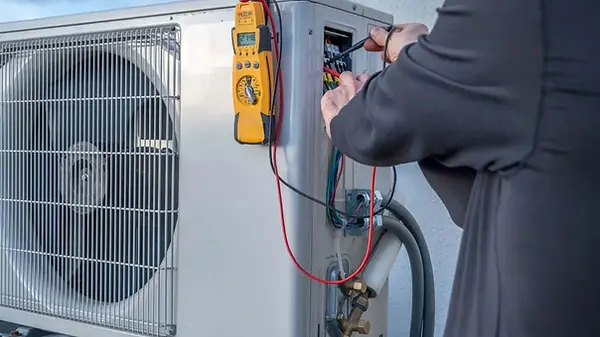
We understand that it’s extremely satisfying when you hear a sound upon turning on the AC. But what if you don’t? Well, that means your AC didn’t turn on. In such cases, the problem mostly stems from the lack of power due to a broken fuse or circuit breaker. The blown fuse or tripped circuit breaker could be a result of thermostat problems, poor wiring, or current leakage. Therefore, you need to replace the blown fuse or check your main supply to see if any circuit breaker tripped.
If your thermostat stopped working, your AC wouldn’t know when to work. You can identify these thermostat problems by setting the temperature at the lowest degree and see if your AC kicks off. If it doesn’t, it’s about time you call us!
If your thermostat is uncalibrated, we would have to calibrate it properly or replace it if broken. These problems usually occur with analog or dial-type thermostats, while some newer ones can also cause problems due to programming issues.
But, if you are willing to take the risk and troubleshoot it yourself, always use the manual that came with the AC because all these components are extremely sensitive.
One of the most common AC problems includes refrigerant top-up. Low refrigerant level will make your AC work hard and ineffectively as the heat discharge isn’t maintained properly.
In several instances, this can occur due to broken contact points or pipe leakages. If your AC is set at a low temperature and still the surrounding remains warm, the chances are that there is an issue with refrigerant. You will experience greater humidity levels.
Refrigerant top-up isn’t just about refilling the gas; it is a much more complex job. Moreover, if your AC is continually low on refrigerant level, you may need to change the entire AC unit.